Every dollar your readers spend on your ebooks tells a story. The question is: how much of that story ends up in your pocket? If you're relying exclusively on Amazon KDP, the answer might surprise you — and not in a good way. Understanding the difference between KDP revenue share vs D2C platforms is no longer a theoretical exercise. It's a business decision that compounds over time.
How KDP's Royalty Structure Actually Works
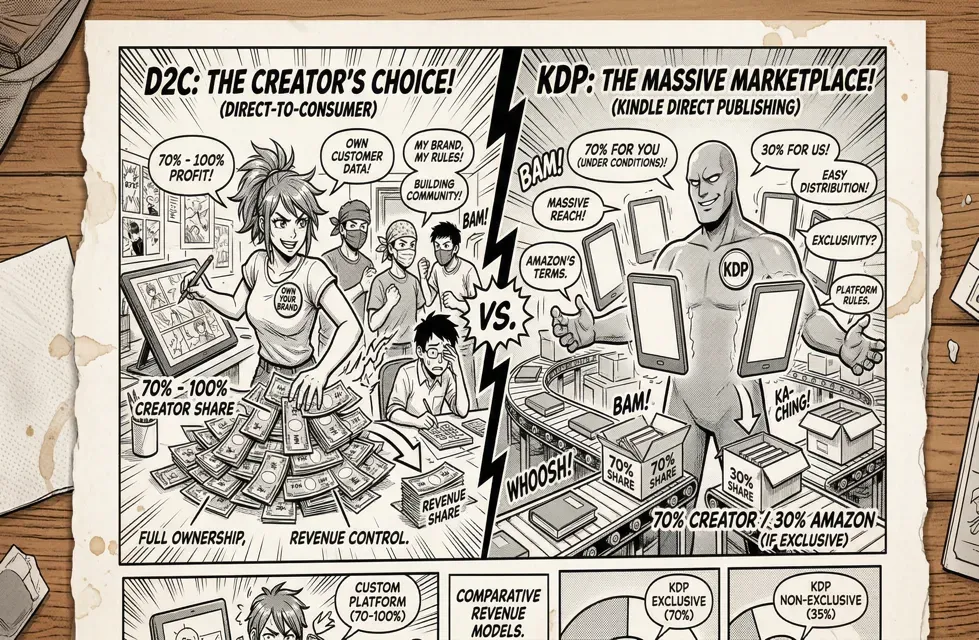
Amazon KDP offers 2 royalty tiers, and the conditions attached to the higher one are where things get complicated. At 70%, your ebook must be priced between $2.99 and $9.99, enrolled in KDP Select (exclusive to Amazon for 90-day rolling periods), and available in specific territories. Drop below $2.99 or price above $9.99 — or sell internationally in certain markets — and you fall to the 35% tier.
That 35% tier is more common than most publishers expect. Academic titles, illustrated books, and bilingual editions often exceed the $9.99 ceiling. Publishers with global ambitions hit territory restrictions. And enrolling in KDP Select means you can't sell that title anywhere else — not your own storefront, not other retailers, not bundled with a subscription.
There's also a delivery fee. Amazon deducts approximately $0.15 per megabyte from your 70% royalty for file delivery costs. A 5MB illustrated ebook priced at $9.99 loses another $0.75 before you see a cent. The math is less friendly than the headline number suggests.
What D2C Revenue Share Actually Looks Like
Direct-to-consumer platforms operate on a fundamentally different model. When a reader buys an ebook through your branded storefront, you're not paying a marketplace for the privilege of existing. You're paying for infrastructure — hosting, payment processing, content delivery, the reading experience — and keeping the rest.
On a platform like Publica.la, publishers typically retain 85–95% of every sale. The variance comes from payment processing fees (which exist regardless of platform) and the plan you're on. There are no delivery fees, no exclusivity windows, no price ceiling that drops you into a penalty tier.
Run the numbers on a $12 ebook sold 500 times in a year:
- KDP at 70% (within the eligible range): $4,200 to you
- KDP at 35% (above $9.99 or outside eligible territories): $2,100 to you
- D2C at 90%: $5,400 to you
That's a $1,200–$3,300 difference on a single mid-catalog title. Scale that across a full catalog, and the revenue gap becomes structural — not incidental.
The Hidden Costs Royalty Percentages Don't Show
Royalty rates are only one dimension of the KDP tradeoff. Three other costs tend to go unaccounted for — until they're already doing damage.
Pricing control. On KDP, Amazon can price-match your ebook to any lower price it finds elsewhere, including a free excerpt or a promotional price you ran months ago. Publishers have had titles price-matched to $0 without warning. You set a suggested price; Amazon decides the actual price.
Data ownership. When a reader buys your ebook on Amazon, that reader is Amazon's customer — not yours. You receive aggregated sales reports. You don't get their email address, their reading behavior, their purchase history with your catalog. Every sale on Amazon is a missed opportunity to build a direct relationship with the people who love your books.
Brand dilution. Your titles appear alongside competitors, generic recommendations, and Amazon's own imprints. Your publishing identity is flattened into a product listing. There's no way to express your brand, curate your catalog, or give readers a coherent experience of who you are as a publisher.
These aren't abstract concerns. They're compounding costs. Every year you spend building Amazon's audience instead of your own is a year of lost leverage — in negotiating power, in reader loyalty, and in the data that drives smarter publishing decisions.
Why the Answer Isn't Choosing One or the Other
Let's be direct: abandoning Amazon entirely isn't the right move for most publishers. Amazon has distribution reach that no single publisher can replicate overnight. Discoverability for new readers, especially in markets where you don't yet have brand recognition, still runs through those algorithms.
The strategic shift isn't Amazon vs. D2C. It's about making D2C your anchor — the channel where your most valuable transactions happen, where you own the relationship, and where you retain the most revenue. Marketplaces become acquisition channels, not your primary revenue home.
This hybrid approach changes the economics meaningfully. A reader who discovers you on Amazon and buys once generates one transaction at 35–70% royalty. A reader who discovers you on Amazon and then finds your branded storefront — through a backmatter link, a newsletter, a bundle offer — becomes a direct relationship generating 90%+ on every future purchase, with data you actually own.
The publishers making this transition most successfully are the ones who treat their storefront as a product, not a fallback. They invest in the reader experience, in catalog presentation, in exclusive content and pricing that makes the direct channel genuinely compelling. For a deeper look at why more publishers are making this move, see our post on direct-to-consumer ebook sales and why publishers are leaving marketplaces.
Building Your D2C Revenue Engine
The practical path to a stronger D2C revenue share starts with a branded storefront that your readers actually want to use. That means a clean, fast reading experience for EPUB, PDF, and audiobooks — on web and native apps. It means payment processing that works across your readers' geographies. And it means the analytics to understand what your catalog is doing, not just how many units moved.
It also means owning your reader relationships from the first sale. Email capture, purchase history, reading preferences — this is the data that tells you which authors are ready for a larger print run, which formats your audience prefers, and which readers are most likely to become loyal subscribers.
Publica.la is built specifically for publishers who want to make this shift without starting from scratch. Our platform powers branded storefronts across publishers, bookstores, and libraries — giving you the infrastructure of a marketplace with the economics and data ownership of a direct channel. You can explore the full publisher solution at Publica.la for publishers.
The Revenue Share Decision Is a Strategy Decision
The KDP revenue share vs D2C question isn't really about percentages. It's about what kind of publishing business you're building. A marketplace-first strategy builds Amazon's audience. A D2C-anchored strategy builds yours.
Publishers who make this shift don't just earn more per sale. They earn compounding advantages: better data, stronger reader relationships, pricing autonomy, and a brand that readers recognize and seek out directly. That's the real return on investing in a direct channel.
If you're ready to understand what this shift could mean for your specific catalog and revenue mix, let's talk through the numbers together. Schedule a call with our team to discuss revenue optimization for your publishing operation.