At some point, every publisher or digital library considers the same question: should we build our own reading app, or use a white-label solution? It’s a decision that affects your budget, your timeline, and your team’s capacity for years to come.
This is not an abstract debate. The numbers are concrete, the tradeoffs are well-documented, and the wrong choice can lock your organization into either excessive spending or inadequate technology. Here’s what you need to know.
The Real Cost of Building a Reading App
Building a reading app from scratch sounds appealing until you scope the actual work. A production-quality reading application needs to handle:
- EPUB rendering with reflowable text, font customization, and accessibility support
- PDF viewing with zoom, page navigation, and fixed-layout fidelity
- Audiobook playback with bookmarking, speed control, and background audio
- DRM integration to protect publisher content
- Offline reading with download management and local storage
- Sync across devices so readers pick up where they left off
- User authentication and account management
- App store compliance for both Apple and Google’s evolving guidelines
Each of these is a non-trivial engineering effort. Together, they represent a full product build.
Development Costs
A custom reading app typically requires a team of 4–6 engineers (iOS, Android, backend, QA) working for 6 to 12 months. At market rates for experienced mobile developers, the initial build alone costs $100,000 to $300,000—and that’s before you’ve addressed ongoing maintenance, OS updates, or feature additions.
For publishers operating outside the largest markets, assembling this team is itself a challenge. Experienced mobile developers with EPUB rendering expertise are not easy to find or retain.
Hidden Costs Most Teams Underestimate
- App store management: Apple and Google update their guidelines, APIs, and review processes regularly. Each OS update can break existing functionality. Someone needs to monitor, test, and patch continuously.
- Device fragmentation: Android alone has thousands of active device models. Testing across screen sizes, OS versions, and hardware capabilities is a permanent workload.
- Security and compliance: GDPR, accessibility standards (WCAG), and app store privacy requirements demand ongoing legal and technical attention.
- Infrastructure: Servers for content delivery, authentication, sync, and analytics add $2,000–$10,000/month depending on scale.
What a White-Label Reading App Delivers
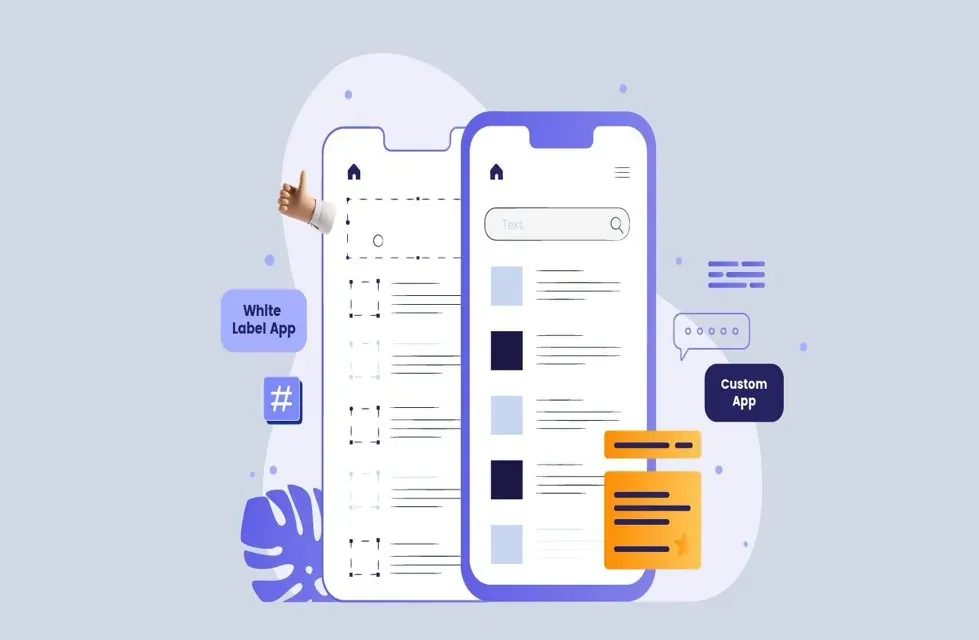
A white-label reading app is a fully built, production-tested application that carries your brand. Your logo, your colors, your name in the app store—but built and maintained by a team that specializes in reading technology.
The core value proposition is straightforward: you get a native app on iOS, Android, macOS, and Windows without building or maintaining the underlying technology. The platform provider handles rendering engines, DRM, OS compatibility, and app store submissions.
What “White-Label” Actually Means
This is worth clarifying because the term is used loosely. A genuine white-label reading app should offer:
- Full branding: Your app name, icon, splash screen, and color scheme—not “Powered by [vendor]” branding forced into the UI
- Your app store listing: Published under your developer account, appearing as your product to readers
- Content control: You decide what’s in your catalog, how it’s organized, and who can access it
- Reader data ownership: User accounts, reading behavior, and engagement data belong to you
If a provider calls it “white-label” but won’t let you publish under your own developer account or forces co-branding, it’s not truly white-label.
Head-to-Head Comparison
Here’s how the two approaches compare across the dimensions that matter most:
| Dimension | Build from Scratch | White-Label Solution |
|---|---|---|
| Upfront cost | $100,000–$300,000+ | $0–$5,000 setup fee (typical) |
| Time to launch | 6–12 months | 2–6 weeks |
| Annual maintenance | $50,000–$150,000/year (team, servers, updates) | Included in subscription fee |
| OS update handling | Your responsibility—each iOS/Android release requires testing and patches | Handled by the provider |
| Platforms supported | Typically 1–2 at launch (iOS + Android); desktop comes later, if ever | iOS, Android, macOS, Windows from day one |
| EPUB/PDF/Audio support | Each format is a separate engineering project | All formats included and tested |
| DRM | Must integrate a third-party DRM provider | Built in |
| Offline reading | Complex to implement reliably across devices | Included |
| App store submissions | You manage review processes, rejections, and policy changes | Provider handles submissions and compliance |
| Customization depth | Unlimited—you own the code | Branding + configuration; core UX is standardized |
| Feature updates | Only when your team builds them | Continuous updates from provider’s product roadmap |
| Risk | Technical debt, key-person dependency, scope creep | Vendor dependency, less control over roadmap |
The Maintenance Trap
The initial build is only the beginning. In mobile development, maintenance typically costs 15–20% of the original build per year. For a $200,000 app, that’s $30,000–$40,000 annually just to keep it functional—not to add features.
Every September, Apple releases a new iOS version. Every year, Google updates Android requirements. Each release can deprecate APIs your app depends on, change permission models, or alter how background processes work. If you don’t adapt, your app starts breaking—or worse, gets pulled from the store.
With a white-label solution, this maintenance burden shifts to the provider. Their engineering team handles OS compatibility across their entire client base, which means the cost is amortized and the response time is faster. When Apple changes its App Tracking Transparency rules, you don’t scramble—your provider does.
The Three-Year Total Cost Comparison
To make this concrete, here’s a realistic three-year cost model for a mid-size publisher:
| Cost Category | Custom Build (3 years) | White-Label (3 years) |
|---|---|---|
| Initial development | $150,000–$250,000 | $0–$5,000 |
| Annual maintenance (x3) | $120,000–$300,000 | Included in subscription |
| Infrastructure (x3) | $72,000–$360,000 | Included in subscription |
| Subscription fees (x3) | — | Varies by provider and catalog size |
| Estimated 3-year total | $342,000–$910,000 | Significantly lower total cost |
Even at the low end of the custom build estimate, the investment is substantial—and it assumes no major rewrites, no team turnover, and no unexpected platform changes. In practice, at least one of those will happen.
When Building Custom Actually Makes Sense
To be fair, there are cases where building your own app is the right call:
- Highly specialized reading experiences that no white-label can accommodate (interactive textbooks with custom simulations, for example)
- Organizations with large in-house engineering teams that have spare capacity and mobile expertise
- Products where the app IS the business—not a distribution channel for existing content, but a standalone product with unique UX requirements
For most publishers, libraries, and content distributors, however, the reading app is a delivery mechanism for their content. The competitive advantage lies in the catalog and the reader relationships, not in the rendering engine.
What to Look For in a White-Label Provider
If you go the white-label route, evaluate providers on these criteria:
- Native apps, not hybrid wrappers: Native iOS and Android apps outperform hybrid frameworks in rendering quality, performance, and app store approval rates.
- Multi-format support: EPUB (reflowable and fixed), PDF, and audiobook support out of the box.
- True white-labeling: Your brand, your app store listing, no forced co-branding.
- Proven app store track record: Ask how many apps they’ve published and maintained. App store experience matters—rejections and compliance issues waste weeks.
- Update frequency: How often do they ship updates? A provider that updates quarterly is keeping up. One that updates annually is falling behind.
- Data access: You should have full access to reader analytics, engagement metrics, and user data through dashboards or APIs.
- Integration with your platform: The app should connect seamlessly to your content management and commerce systems.
The Bottom Line
Building a reading app from scratch is a major product investment. It demands specialized talent, ongoing maintenance, and constant adaptation to platform changes. For publishers whose core competency is content—not mobile engineering—it diverts resources from what actually differentiates the business.
A white-label reading app lets you launch faster, spend less, and focus your team on content strategy, audience growth, and reader relationships. You get a professional, branded reading experience across all major platforms without the engineering overhead.
The question isn’t whether you can build your own app. With enough budget and time, any organization can. The question is whether that’s the best use of your resources when proven, brandable alternatives exist.
For most publishers, the answer is clear.
Ready to launch your branded reading app? Explore Publica.la’s platform for publishers to see how our white-label native apps work in practice, or schedule a meeting to discuss your specific requirements.