Publishers today face a question that wasn't on anyone's radar a decade ago: which digital format should anchor their catalog strategy? The answer isn't as simple as picking a favorite. EPUB, PDF, and audiobooks each serve distinct reader needs — and the publishers who understand this distinction are the ones building the most resilient digital businesses in 2026.
This post breaks down each format's strengths, limitations, and ideal use cases, so you can make a confident, data-backed decision for your catalog and your readers.
EPUB: The Gold Standard for Reflowable Reading
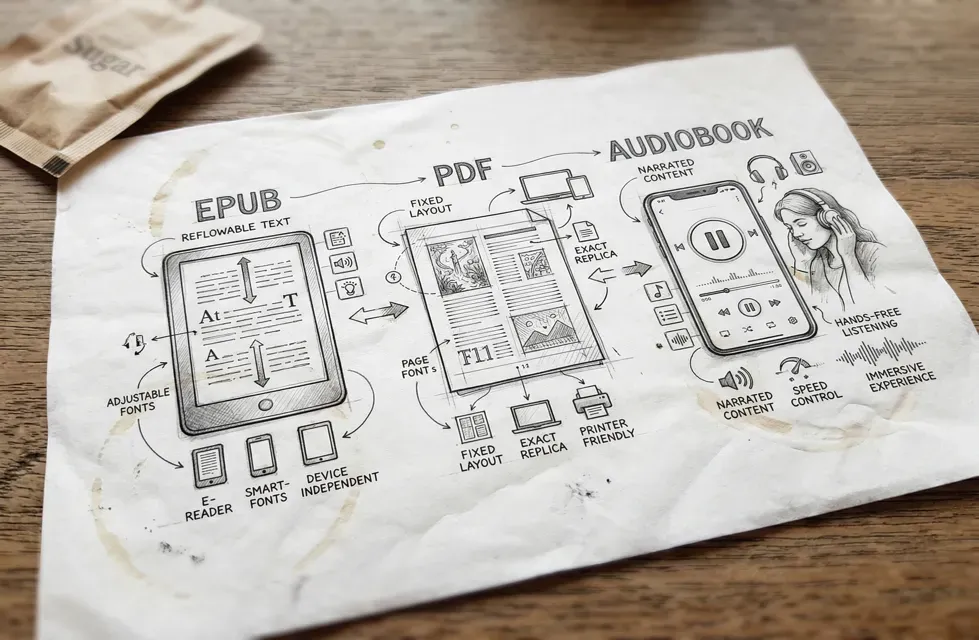
EPUB is the format that most closely mirrors the experience of reading a physical book on a screen. Text reflows to fit any device, readers can adjust font size and line spacing, and the experience adapts naturally from a 6-inch e-reader to a tablet to a desktop browser.
For publishers distributing trade fiction, popular non-fiction, and narrative-driven content, EPUB is typically the right choice. It supports rich metadata, embedded fonts, chapter navigation, and — with EPUB3 — interactive elements, audio, and video. The format is widely supported across all major e-reader platforms and devices.
Key advantages of EPUB for publishers:
- Optimized reading experience on any screen size
- Strong support for accessibility features (screen readers, adjustable type)
- Native support in most distribution channels and reading apps
- EPUB3 enables multimedia and interactivity for enhanced editions
- Smaller file sizes compared to PDF, which reduces delivery costs
The main limitation is fidelity. If your book relies heavily on a fixed layout — tables, complex diagrams, poetry with precise line breaks — EPUB can distort the intended design. That's where PDF earns its place.
PDF: When Visual Fidelity Is Non-Negotiable
PDF is the format of precision. What you design is exactly what readers see, regardless of the device or operating system. For academic publishers, legal publishers, textbook producers, and anyone working with illustrated content, PDF remains irreplaceable.
Think about a technical manual with multi-column layouts, a cookbook with full-bleed photography, or a law journal with exact footnote placement. Reflowing that content would destroy the reading experience. PDF holds the design intact.
Where PDF works best:
- Academic and scholarly publishing with complex layouts
- Technical documentation and manuals
- Illustrated non-fiction, art books, and cookbooks
- Legal, medical, and regulatory documents
- Content that will be printed by readers
The trade-off is mobile readability. A PDF designed for an A4 page becomes frustrating to read on a phone without zooming and panning. For publishers targeting mobile-first readers, this matters — and it's why many catalog strategies now include both EPUB and PDF versions of the same title.
Audiobooks: The Fastest-Growing Format in the Room
Audiobooks are no longer a niche format. Global audiobook revenue surpassed $7 billion in 2024 and continues to grow at double-digit rates year over year. Commuters, exercisers, parents with their hands full — these readers aren't browsing screens. They're listening.
For publishers, audiobooks represent both an opportunity and a production investment. Unlike EPUB or PDF, which can be created from a manuscript with relatively modest tooling, producing a quality audiobook requires narration, audio engineering, and quality control. That said, the economics increasingly make sense. Audio listeners tend to be higher-spending readers with strong platform loyalty, and audiobook titles command premium pricing.
Publishers who benefit most from investing in audio:
- Trade fiction and narrative non-fiction publishers with a broad reader base
- Children's and young adult publishers (the segment is growing fast)
- Business book publishers targeting time-pressed professionals
- Publishers building direct-to-reader relationships and subscription models
If your catalog doesn't yet include audio, even starting with your top 20 titles can meaningfully expand your reach and open a new revenue stream — without disrupting your existing EPUB and PDF catalog.
The Real Answer: Format Strategy, Not Format Choice
Framing this as "which format should I pick?" is the wrong question. The publishers building durable digital businesses in 2026 aren't choosing one format — they're building a multi-format strategy that matches format to reader context.
A practical framework:
- Trade fiction and narrative non-fiction → Lead with EPUB, add audio for top titles
- Academic, technical, and illustrated content → Lead with PDF, consider EPUB for mobile accessibility
- Business and self-help → EPUB plus audio; readers want flexible access across contexts
- Children's and educational content → EPUB3 with multimedia, audio for engagement
The goal is to meet readers where they are, not to optimize for a single delivery mechanism. Readers who discover your content in audio may buy the EPUB to highlight passages. Readers who read the PDF for work may recommend the audiobook to a colleague. Each format expands your reach.
Distribution Infrastructure Makes Format Strategy Possible
Having a great multi-format catalog only creates value if readers can actually discover, purchase, and access it — from a storefront that reflects your brand, not someone else's. That's the piece many publishers overlook when thinking about format strategy.
When you're ready to go beyond format selection and think about how to build a direct channel to your readers, choosing the right ebook platform for your publishing business is the next essential decision. The infrastructure you choose determines how much of the reader relationship you actually own.
Publica.la enables publishers to distribute EPUB, PDF, and audiobooks from a single branded storefront — with native reading apps, built-in analytics, and direct payment processing. No intermediaries, no revenue splits beyond your own pricing decisions. You can learn more about how the platform works for publishers at Publica.la for publishers.
Your Format Strategy Starts with Your Readers
The right format mix isn't determined by trends or what competitors are doing. It's determined by understanding your readers: how they consume content, on which devices, in which contexts. Publishers who start from that understanding — and build their catalog and distribution infrastructure accordingly — are the ones gaining ground in 2026.
If you want to talk through your catalog's format strategy and how to distribute it directly to readers, schedule a call with our team. We work with publishers across categories and markets, and we'd love to help you figure out the right approach for yours.